No fee to stroll
Lantern lanes
Hanamikoji and Pontocho
- CostStreets free to walk
- DinnerIzakaya or riverside
- RuleDo not photograph residents
Guides
Language
Currency
Look up datestickets from $97 · no-fee cancellationFind it on the map
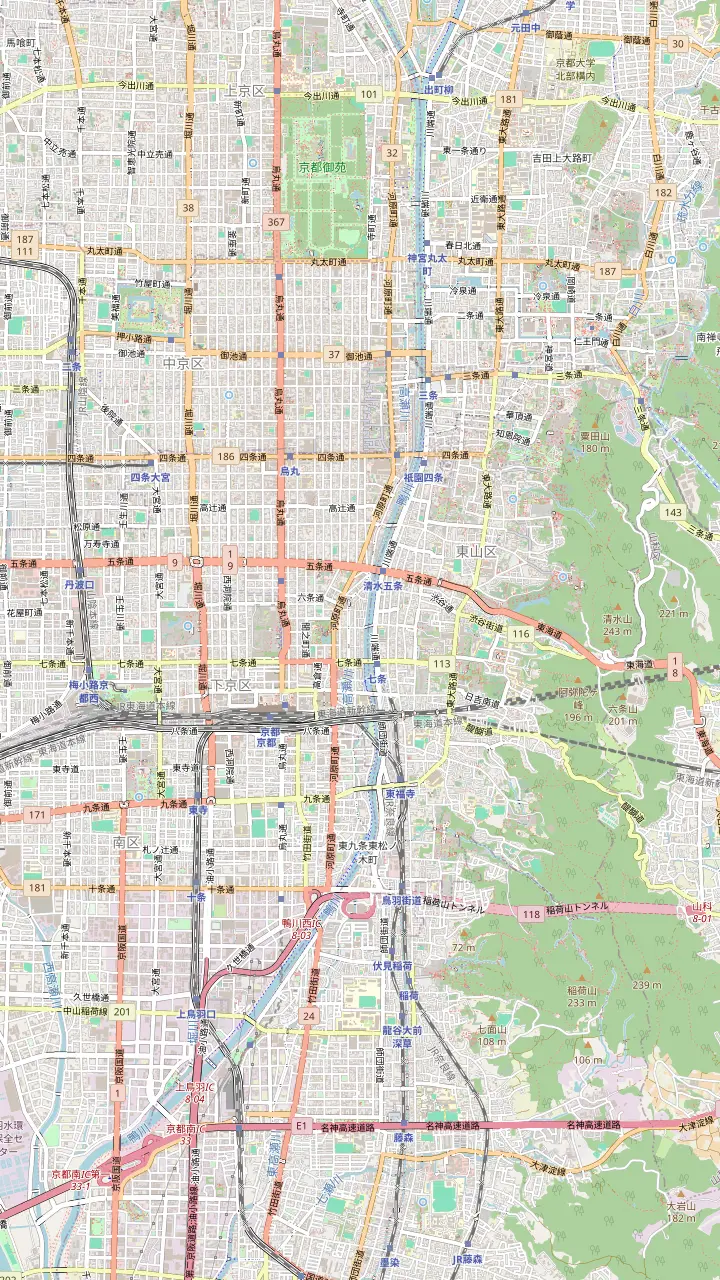
42 spots on the map
Select a district, then a marker or a name to read about it and open directions.
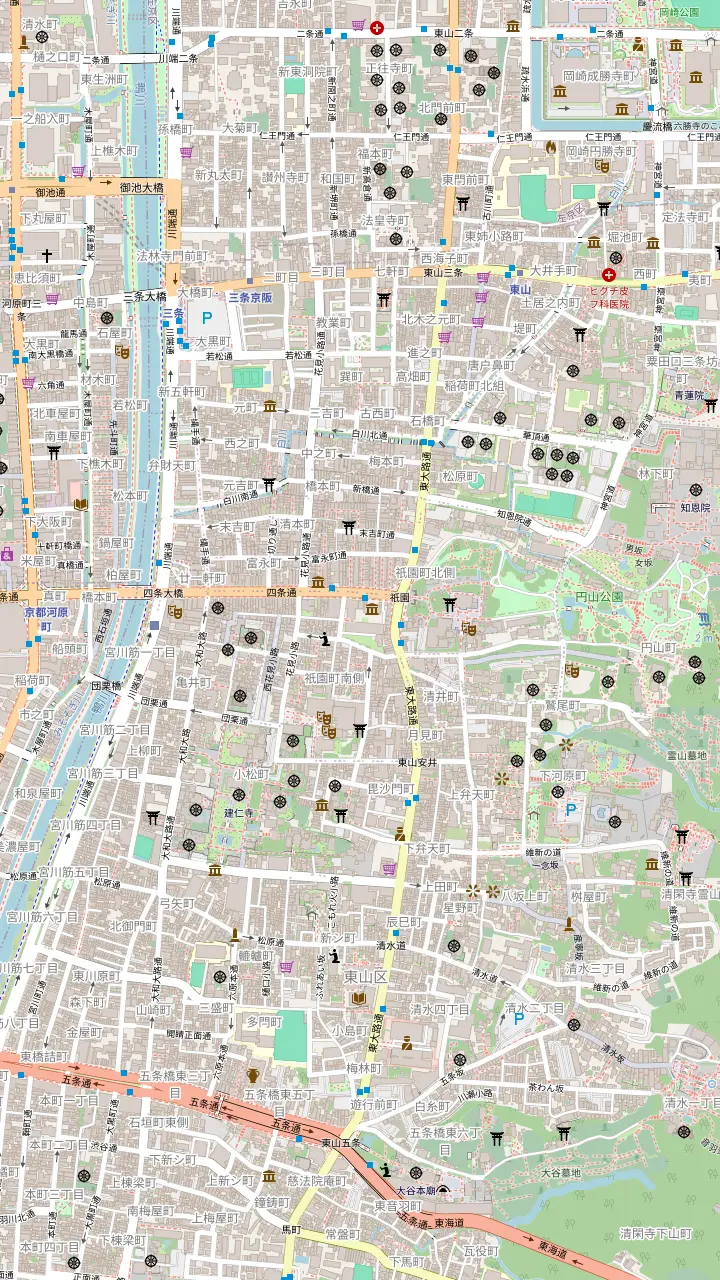
From the station walk east along Shijo to Hanamikoji Street and straight down it to reach Kennin-ji.
The meeting point of the 100-minute Gion night walk limited to 10 people.
Runs between Sanjo and Shijo streets; its history as an entertainment district goes back to 1670.
A 2-hour guided walk lists Shirakawa Lane and Tatsumi Bridge as its first stops.
Has no formal sidewalk, but different stones in the center and at the sides mark where pedestrians should walk.
Outside its winter schedule, regular shows start every day at 6:00 pm and 7:00 pm and last about 50 minutes.
Admission is 800 yen for adults; visitors are accepted from 10:00 a.m.
The shrine office is open 9:00 to 17:00.
Admission is 800 yen for adults, with daytime hours of 9:00 am to 5:00 pm.
Each March the park becomes a lantern festival with thousands of lanterns.
The Nozomi bullet train takes approximately 130 minutes from Tokyo Station to Kyoto Station.
Google MapsBeside Inari Station on the JR Nara Line, 2 stations and 5 minutes from Kyoto Station, per the shrine.
Google MapsFounded in 778; it opens at 6:00 a.m. every day.
Google MapsGion grew up as a gate town in front of Gion Shrine, now called Yasaka Shrine.
Admission is 1,000 yen for adults, and a visit usually takes about 30 minutes.
Open 9:00 a.m. to 5:00 p.m. all year round, with admission of 500 yen for adults.
Google MapsCastle admission is 800 yen for adults; it was completed in 1603.
Google MapsAdmission is free, and the palace is closed on Mondays.
The JR Sagano Line Rapid Service takes about 11 minutes from Kyoto Station to Saga-Arashiyama Station.
Google Maps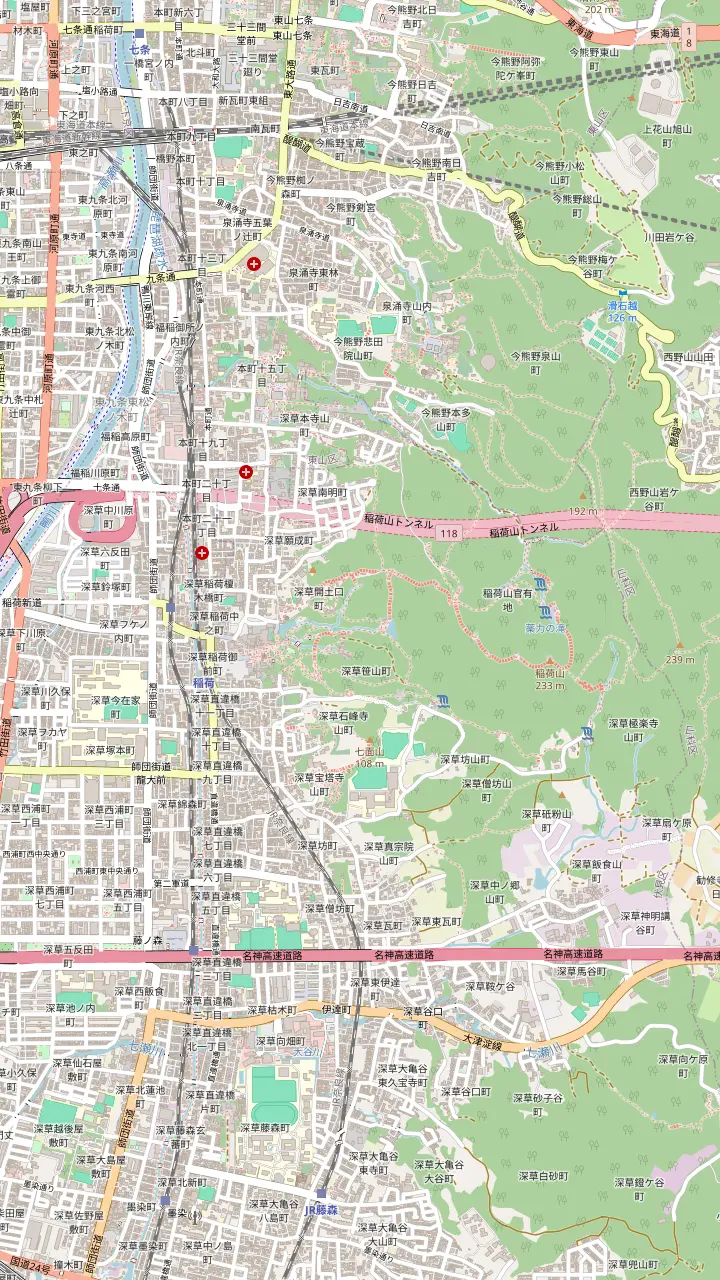
Local Nara Line trains stop here; JR West warns that express trains do not.
The shrine is a 5 minute walk east of the station; limited express trains do not stop here.
Said to have been built by Toyotomi Hideyoshi in 1589.
Rebuilt in 1499 and a designated Important Cultural Property.
JNTO describes a row of 1000 scarlet torii along a 4 km path.
Moved to its current location in 1975.
At the pond tradition says clapping echoes from the direction where a lost person can be found.
The highest peak of Inariyama at 233 m.
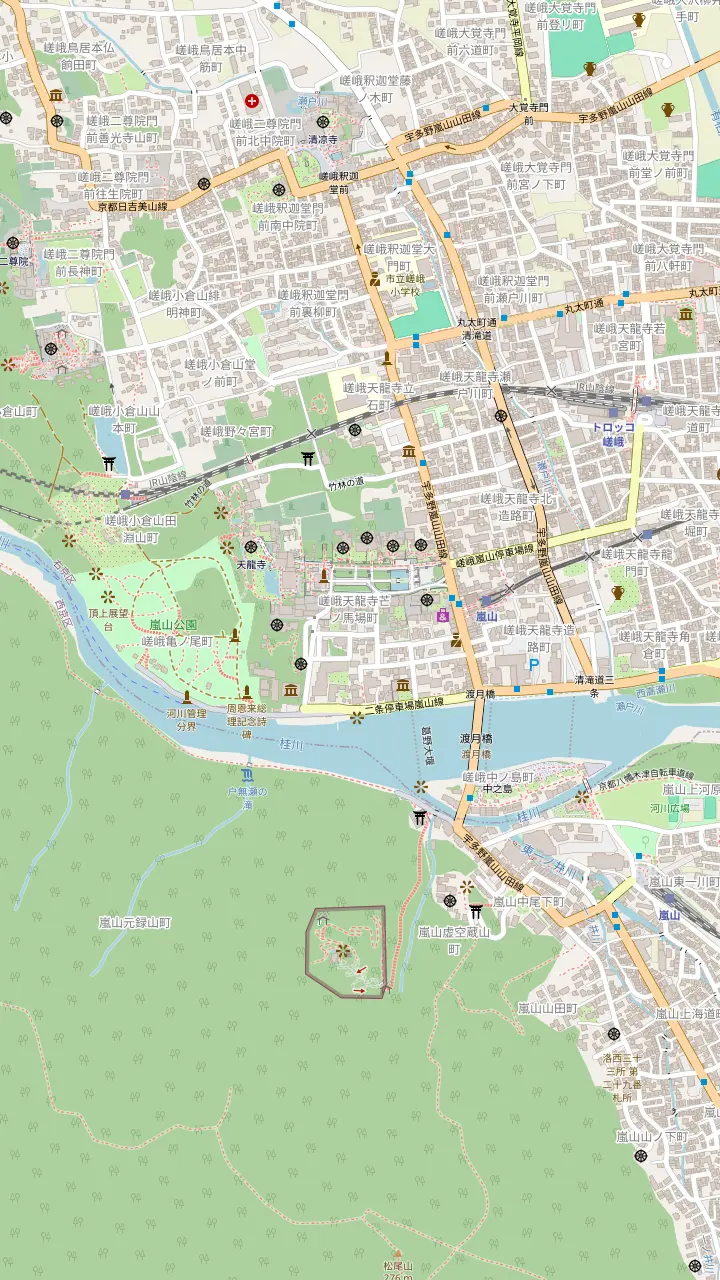
The bamboo grove is a 10-minute walk from this station.
Google MapsTenryu-ji is a 5-minute walk from Randen Arashiyama Station.
Google MapsFirst built in 836; the current bridge was finished in 1934.
Opens 8:30am to 5:00pm; garden-only admission is 500 yen for adults.
Entry is free.
The grove lines a 400 meter path between Nonomiya Shrine and Okochi Sanso Villa.
Admission is 1,000 yen for adults and includes matcha and sweets.
Admission is 800 yen for adults, cash only; the climb to the monkeys takes about 20 minutes.
The observation deck is open 10:00 to 21:00 with last admission at 20:30.
Kamogawa Noryo Yuka riverside dining runs from May 1 to October 15.
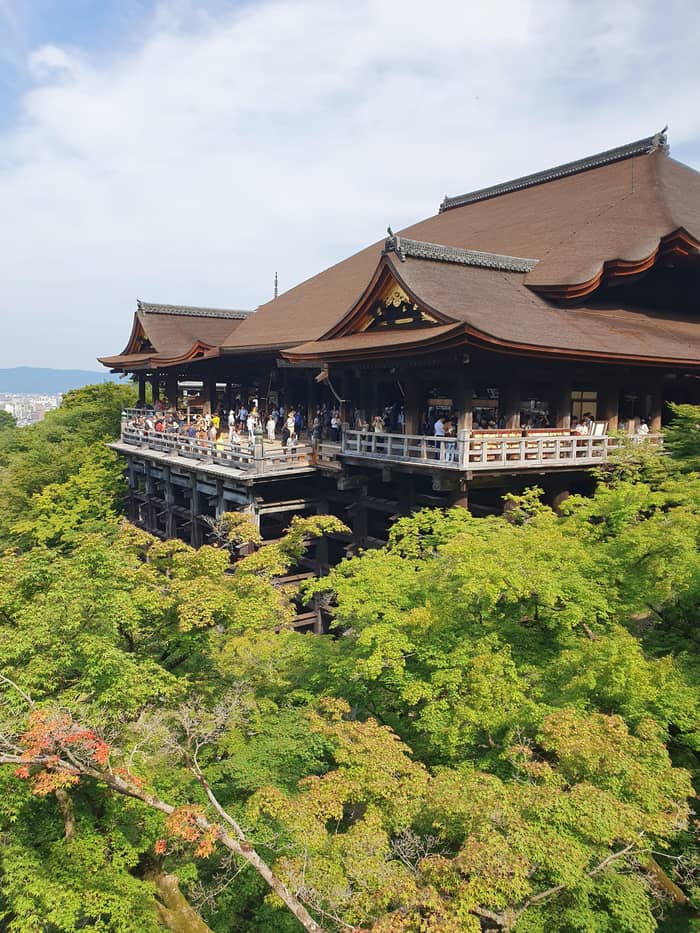
After dark the stones of Hanamikoji are lit with lantern light.
The temple holds its special night viewing three times a year.
Google MapsThe Special Autumn Nighttime Viewing and Illumination runs from 23 Oct to 13 Dec 2026.
The 2026 cherry blossom light-up ran from 6 p.m. to 10 p.m., with last entry at 9 p.m.
Google MapsJR West notes that the shrine is never closed to the public.
Google MapsCartography © OpenStreetMap contributors
Kyoto's shops close early, but its streets and temples do not go dark. Here are the night walks, the dated temple openings and the late transport that make the evening work.
Editorial team, kyotoactivities.com · Updated November 2, 2026 · About 7 minutes of reading
Evening cheat sheet
Kyoto's tourism site counts night sightseeing as anything after 6:00 PM.1 That matters in winter, because sunset is around 5:00 PM then, while in summer it is around 7:00 PM.6 So the same hour can mean full dark in December and daylight in July, and your plan should follow the season rather than the clock.
Shops tend to close fairly early, but in Kyoto many shrines and temples put on special light-up events during the autumn leaf and cherry blossom seasons, and open their doors for special nighttime openings.7 The practical rule that follows is simple: pick your evening around an opening that has a date, then fill the hours around it with a lane walk and dinner.
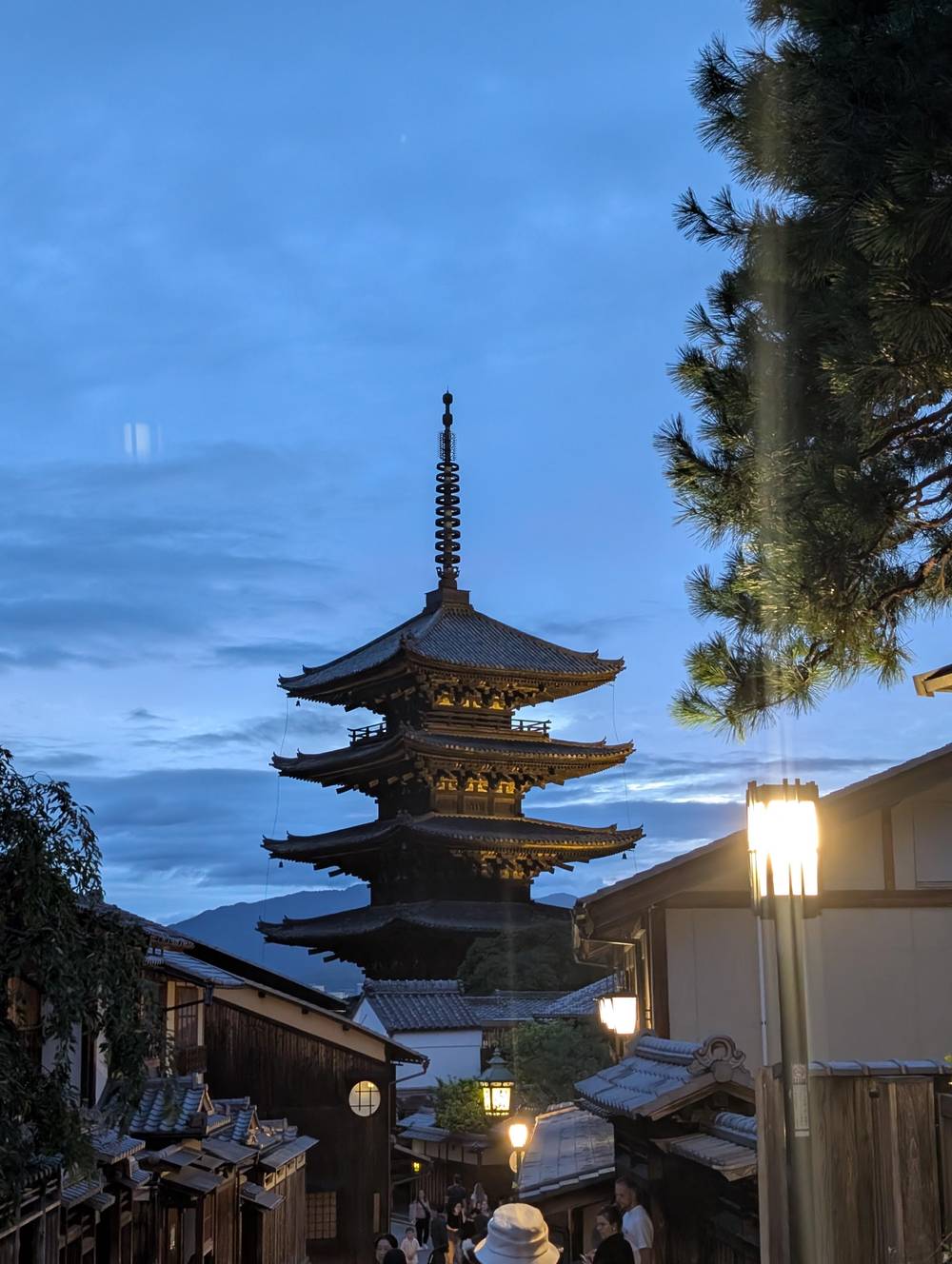
Not every famous street is lively at night. The temple road around the Yasaka Pagoda at Hokan-ji is bustling with tourists in the daytime, but the number of visitors suddenly drops at night.8 That makes it a calm place to walk, with fewer people in the frame and a different mood, but do not expect the shopping to be open.
Evening openings
| Place | When | Hours | Note |
|---|---|---|---|
| Kiyomizu-dera | Mar 27 to Apr 5; Nov 21 to 30 | Until 9:30 pm | Last entry 9:00 pm |
| Kodai-ji | Mid-March to early May; Aug 1 to 18 | 5:00 to 9:30 pm | Autumn: 23 Oct to 13 Dec |
| Nijo Castle | Mar 19 to Apr 19 | 6 to 10 pm | Last entry 9 pm |
| Kyoto Tower | Daily | 10:00 until 21:00 | Last entry 20:30 |
| Fushimi Inari | Every night | Never closed | Lit after dark |
Dates are the 2026 editions published by the temples, the castle and the Kyoto City Tourism Association; check them again before you travel.12,24,11,25,26,27,28,4
After dark the stones of Hanamikoji are lit atmospherically with lantern light, creating a scene that looks very different from its daytime counterpart.2 Respect the street while you enjoy it: Hanamikoji and Gion-Shirakawa are residential areas, and visitors are asked to follow local manners and not photograph residents.14 Our Gion guide sets out the rules in full.
Pontocho runs between Sanjo and Shijo streets and mostly sleeps by day and comes alive at night.9 Its history as an entertainment district goes back to 1670, and its lanterns carry the district's emblem of a white plover.15,16 The nearest stations are Sanjo Keihan and Gion Shijo on the Keihan Line and Kyoto Kawaramachi on the Hankyu Line.17
In warm months the restaurants build platforms over the river. Kamogawa Noryo Yuka riverside dining runs from May 1 to October 15 and is said to date back to the 1600s.18,19 At an izakaya, the small starter dish called otoushi typically costs between 300 and 500 yen per person, so expect it on the bill rather than being surprised by it.10
Ride money
Kiyomizu-dera holds its special night viewing three times a year. In 2026 the spring viewing ran March 27 to April 5, the summer one August 14 to 16, and the autumn one November 21 to 30; spring and autumn open until 9:30 p.m. with last entry at 9:00 p.m.3,12,31,24 The temple itself opens at 6:00 a.m., and its closing time changes with the season and the night viewings.32
Kodai-ji has its own pattern. Its spring night opening runs from mid-March to early May from 5:00 p.m. to 9:30 p.m. (entrance closing), the summer one August 1 to August 18 with the same hours, and the Special Autumn Nighttime Viewing and Illumination runs from 23 Oct to 13 Dec 2026.11,33,25 The temple was founded in 1605 by Nene, widow of Toyotomi Hideyoshi.34
Nijo Castle usually closes to visitors at 5 p.m. but holds a light-up event during cherry blossom season.35 The 2026 Sakura Festival ran 32 days from March 19 to April 19, with the light-up from 6 p.m. to 10 p.m. and last entry at 9 p.m.26,27 About 200 cherry trees inside the grounds are illuminated, and the annual passport cannot be used for special events such as nighttime lighting, so budget for a separate ticket.36,37
Pick a night
Choose by season, budget and appetite for walking.
If It is spring or autumn
A temple light-up
Kiyomizu-dera and Kodai-ji open late on dated evenings.12,11
If I am here in July
Yoiyama evenings
July 14 to 16 and July 21 to 23 in 2026.29
If I am here on August 16
Watch the Okuribi
The first fire is lit at 8:00 PM.30
If I want no tickets
Walk Gion and Pontocho
Lantern light on the stones and lanes that come alive at night.2,9
If I want a guide and dinner
The 3-hour evening tour
Two restaurant stops from $128.
Pick a style of night
No fee to stroll
Hanamikoji and Pontocho
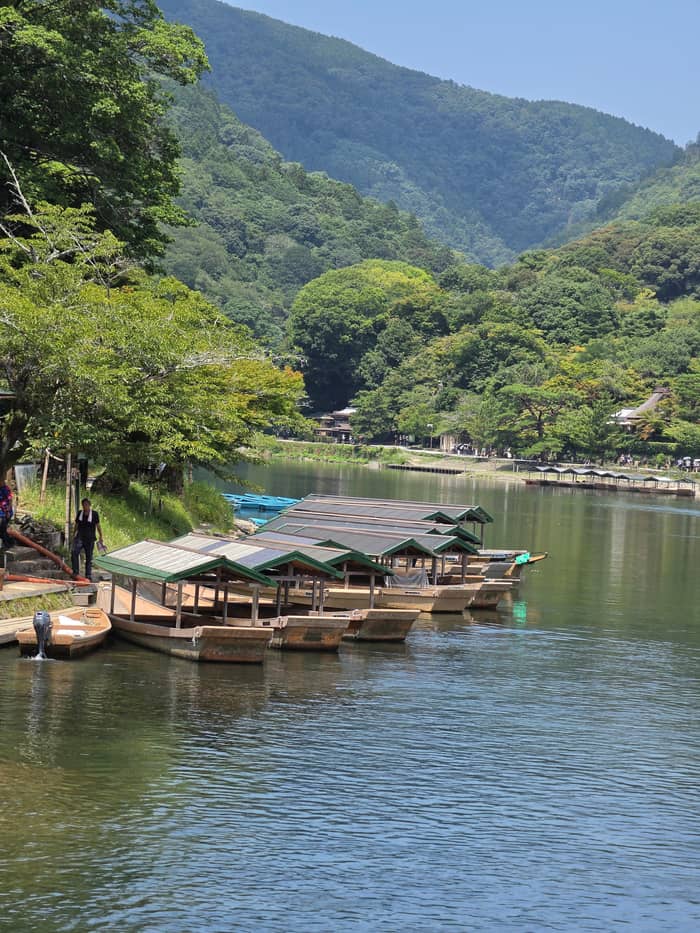
Seasonal
Kiyomizu-dera, Kodai-ji
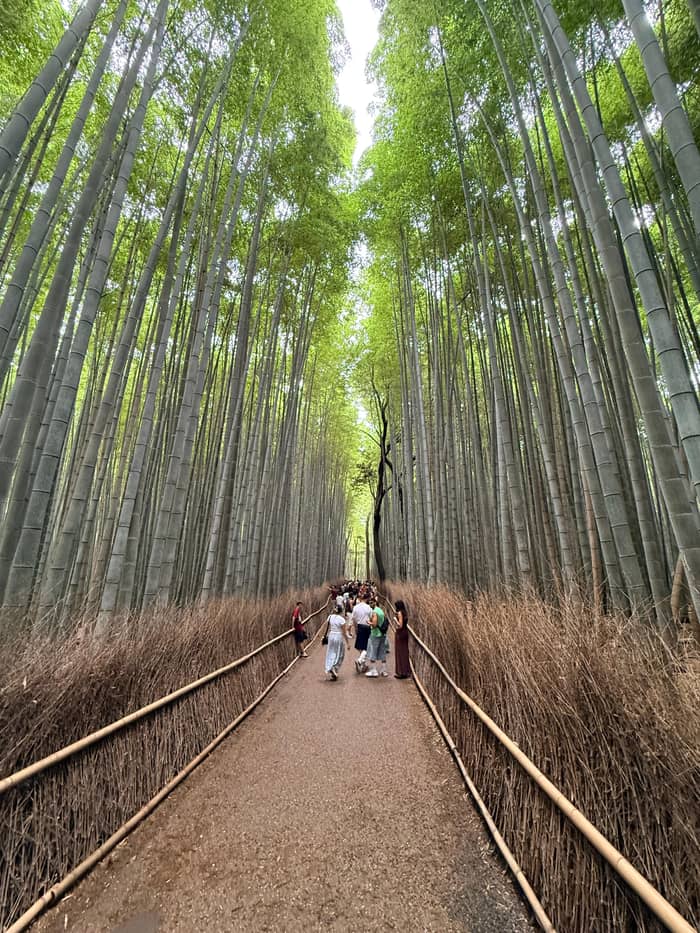
Plus dinner stops
Gion, Kamo River, Pontocho
The head Inari shrine is one of the few big sights that never shuts. JR West notes that Fushimi Inari Taisha is never closed to the public, and JNTO says it can be visited at any time of the day.4,81 JNTO also suggests visiting early in the morning when fewer people are around, or after dark when the shrine is lit up, for a different kind of experience.82
The Kyoto City Tourism Association describes the path behind the shrine, with over 5000 orange torii, and calls the walk around the upper precincts a delightfully eerie stroll in the late afternoon and early evening.83,84 The key idea is that the first tunnel of gates is the sensible limit for a first night visit. The mountain is 233 m high and walking it takes between two and three hours, which is a daytime plan.85,86
If you want a guide, a 2-hour night walk meets at the fox statue at the main entrance of the shrine, has an English-speaking guide, and costs from $41, with 257 reviews at 4.92. Our Fushimi Inari hike page covers the trail itself, with its stages and what the shrine asks of walkers.
Evening cost
Enter your group size to compare the evening options.
4 options side by side
Enter your group size to compare the evening options.
≈
View≈
View≈
View≈
ViewLowest GetYourGuide prices at the ECB reference rate; the exact amount appears when you book.
A sample night
Kyoto Tower's observation deck is open 10:00 to 21:00, with last admission at 20:30.28 On August 16 it closes earlier, at 6:30 p.m. with last entry at 6:00 p.m., so a plan to watch the fires from the tower will not work.87 Children under 3 enter free.88 The tower is the tallest building in the city and stands close to Kyoto Station.89
A cheaper view is built into the station. The grand staircase of the Kyoto Station Building is illuminated from 4 p.m. to 10 p.m. and offers a view of Kyoto Tower.90 It is a useful first or last stop, because you pass through the station anyway on the way to and from the trains.
Higashiyama has its seasonal glow as well. Each March Maruyama Park becomes a lantern festival with thousands of lanterns, and buses 100 or 206 from Kyoto Station reach the Gion stop in about 20 minutes, a short walk from the park.80,91 Check the official calendar for the exact dates before you plan around it.
Video
YouTube channel Japan by Food · The player connects to YouTube only after you tap.
At night, the stones of Hanamikoji are lit atmospherically with lantern light, creating a scene that looks very different from its daytime counterpart.
Checklist
Two nights carry a whole month of planning. The Gion Matsuri evenings called Yoiyama ran July 14 to 16 and July 21 to 23 in 2026, and during them old houses in Yamahoko-cho open tatami rooms to display folding screens and other treasures.29,92 Yoiyama means procession eve, and the festival day was once believed to begin at sunset on the evening before.93
On the evening of August 16 the Gozan Okuribi sends off ancestors' spirits.94 Daimonji is lit at 8:00 PM, followed by Myo-Ho at 8:05 PM and Funagata at 8:10 PM, then Hidari Daimonji at 8:15 PM and Toriigata at 8:20 PM.30,95 JNTO says each fire burns for about 40 minutes and 8:30 p.m. is the moment when all are visible at once.96
Safety rules are firm. Entering the hills where the Okuribi fires burn on August 16 is prohibited for safety, and the trails have no lights.97 Visitors are advised not to enter the dark riverbanks at night to watch the fires.98 If you cannot find a viewpoint, a livestream near Kamo Ohashi Bridge was set to run around 6 PM to 9 PM in 2026.99 Plan the last leg back before you settle on things to do at night in Kyoto.
FAQ
Kyoto's tourism site counts night sightseeing as anything after 6:00 PM.1
JR West notes that the shrine is never closed to the public.4
The Kyoto City Subway generally operates from 5 o'clock to 23 o'clock.103
Sources
Questions about Kyoto or the tours? Ask a person here.